A Maritime Chronicle
The Steamboat
The City of Sanford was built and launched in Jacksonville in 1880. Its launch site, on East Bay St., is in the heart of Jacksonville’s new Shipyards Park West. (Launched near the planned Riverwalk, a historic marker application is in process.). Its shipwreck is believed to be the earliest remaining relic of Jacksonville’s shipbuilding industry.
Although the City of Sanford boasted 12 first class passenger cabins, dining and a saloon, it was specifically designed to consistently carry 145 tons of agricultural products to Jacksonville for northern export. The City of Sanford was state of the art construction in 1880 specifically built for the St. Johns River.
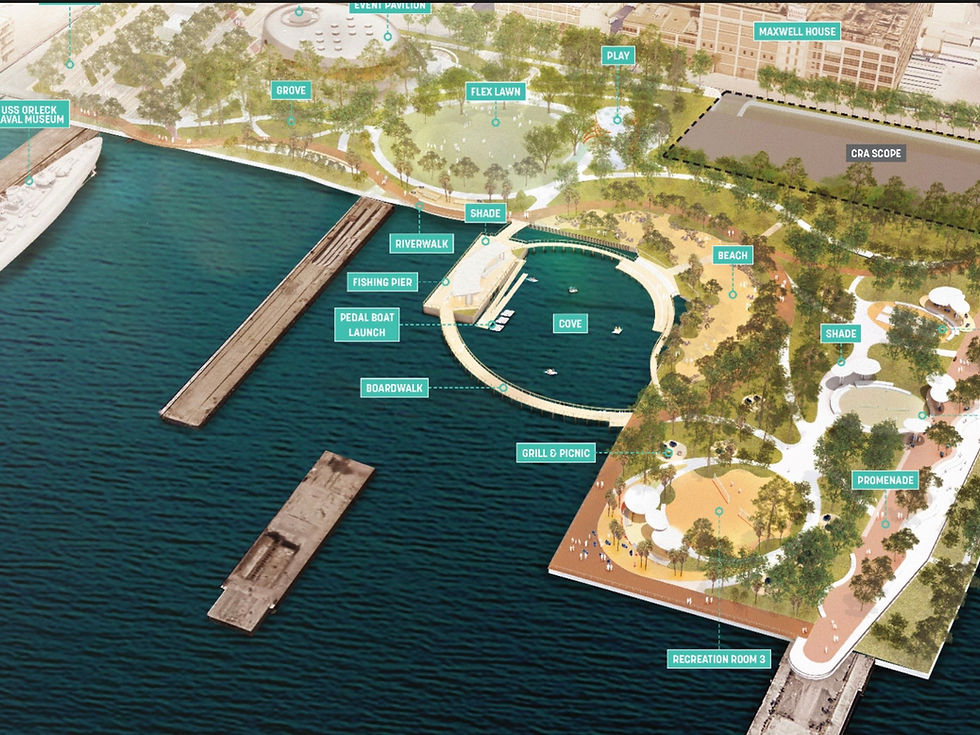
Jacksonville Shipyards Park West planned development, 2026.
George Chase and Jacob Brock

George Chase, the City of Sanford’s builder, was a protege of Jacob Brock, the most knowledgeable steamboat man in Florida history. He built a home and shipyard in Jacksonville and a three story hotel on Lake Monroe 200 miles further south.
Brock had been in Florida since the 1850’s shortly after Florida became a state. His side wheel steamboats initially serviced a small population of settlers and invalid tourists seeking better health. During the 1870’s, after the Civil War and Reconstruction, interest in Florida surged bringing an influx of speculators, adventuresome hunters and northern businessmen.
Chase, who had come to Jacksonville in the 1850’s, opened his shipyard in 1878 after Brock died in 1877. It was located just south of Brock’s former wharf near 25 year old James Merrill’s blacksmith shop. The Jacksonville & Fernandina railroad and riverfront depot, built in 1881, routed directly through the center of Chase’s shipyard forcing him to relocate after the City of Sanford launch.
Jacob Brock with his son and workers c1870


Brock House, Enterprise Florida, Scenes of Florida, published A.F. Styles Burlington VT c1875
1885 Map showing railroad built through Chase Shipyard (far right)
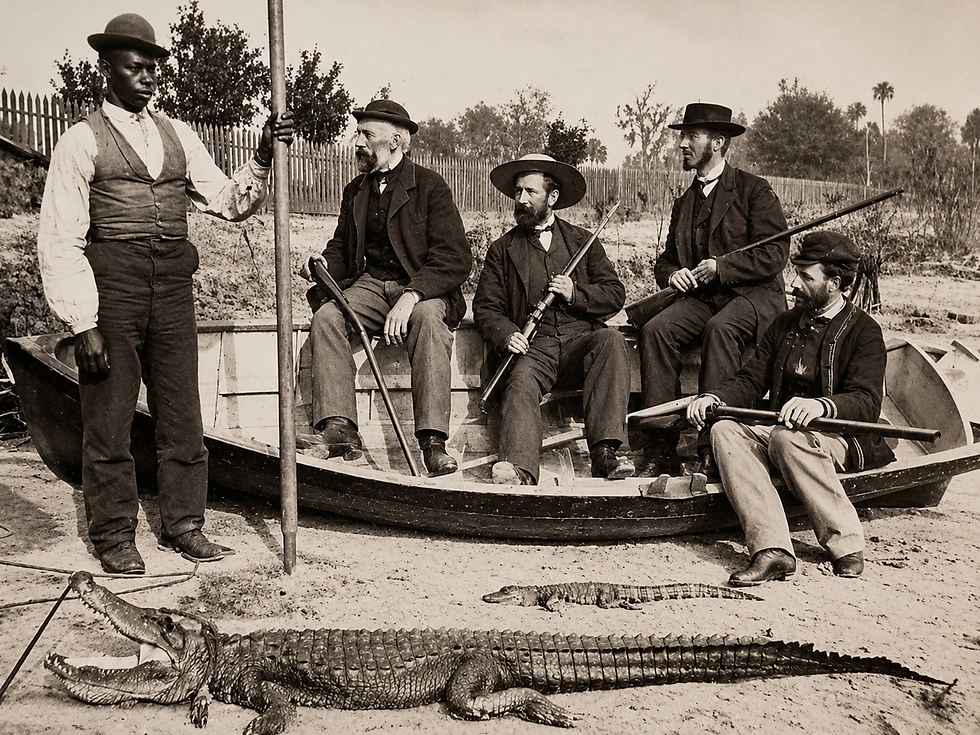
The Alligator Party, Scenes of Florida, published A.F. Styles, Burlington VT c1875
Contruction and Use
Considered a “boat of the future”, the City of Sanford was not a side wheeler but a state of the art stern wheeler built specifically for river use. It was designed to consistently carry maximum loads up and down the shallow, twisting St. Johns river.
Likely built from buoyant long leaf pine or oak, the 129’ steamship had a flat bottomed wooden hull and 4.5’ draft. It was specifically designed to carry 48 deck and cabin passengers, 21 crew and 145 tons of freight.
A hog chain network, operated with a turnbuckle, adjusted the distribution of the freight weight. The hog chains minimized the ship’s draft which was a valuable asset on a shallow river with drifting sandbars. The stern wheel design provided more freight area and easier access to the main deck than the traditional side wheeler.
Twelve luxurious cabins, dining and a saloon were on the deck above where deck passengers could also access the saloon. The uppermost deck, called the hurricane deck, included the “Texas”, officer cabins and nearby pilot house.
The Florida Mirror, dated October 23, 1880, documented the City of Sanford’s christening.
"…the new stern wheel steamer City of Sanford was successfully launched. Miss Lulu Payne, as the vessel glided down the ways, broke a bottle of champagne at the bow(s), and christened her with the name…"

Example of similar stern wheeler built in 1901
with hog chain engineering.
A Triumph!

The City of Sanford was a goldmine. Launched at the peak of the citrus boom and ”orange fever”, it carried tons of supplies down the river to the new settlements and brought tons of citrus and early vegetables back up the river to load into rail cars.
Only 18 steamboats were operating on the St. Johns River in 1880. Most of those were older, imported side-wheelers built elsewhere. They mostly serviced the deeper, wider parts of the river to include St. Augustine (Tocoi), Palatka, and Green Cove Springs, all within 50 miles of Jacksonville. Only a few regularly made the winding, 400 mile roundtrip to Lake Monroe.
Only one was a custom built stern wheeler specifically engineered to haul 145 tons of passenger and agricultural freight, run a twice weekly 400 mile roundtrip schedule, and never miss a sailing.
That steamer was the City of Sanford!
AI used for illustrative purposes.
No photos of the City of Sanford have been located.